The Regenerative Peptides
Your Body Already Knows
Defensins are among the oldest and most powerful molecules in your immune system. They don’t just protect. They regenerate.
Your Body’s Regenerative Signal
Doesn’t Last Forever
Two things are happening simultaneously, and they are deeply connected.
Your skin’s ability to regenerate, replace old cells, produce collagen, and recover from damage, declines steadily every decade.
At the same time, your body’s natural defensin peptides, the molecules that signal skin and hair regeneration, are declining in parallel.
What This Means
Slower Healing
Recovery takes longer after procedures, sun exposure, and daily microdamage.
Less Regeneration
Cell turnover slows from ~28 days in your 20s to 75–90 days in your 60s.
Visible Aging
Less collagen production, compromised barrier, fine lines, loss of firmness.
Diminished Results
Procedures and products become less effective as the regenerative signal fades.
This isn’t just a skin story. Hair follicles follow the same pattern: less time in the growth phase, shorter cycles, miniaturization, and diminished blood supply. The follicles aren’t gone. The signal telling them to grow has weakened.
What Are Defensins?
Naturally occurring peptides your body has produced since birth.
Defensins are part of your innate immune system, first studied in the 1980s and now one of the most researched peptide families in immunology. For decades, science recognized them primarily as antimicrobial agents.
But here’s what recent research has revealed: defensins don’t just defend. They regenerate.
Two specific defensins, Alpha-Defensin 5 and Beta-Defensin 3, have been shown to activate regenerative pathways in both skin and hair. Together they signal stem cells, activate fibroblasts, trigger growth factor cascades, stimulate the Wnt pathway, and regulate pigmentation. (Lough et al, 2013; Takahashi et al, 2021; Candille et al, 2007)
This makes defensins something rare: molecules your body already produces, already recognizes, and already knows how to use, with protective, regenerative, and restorative functions built into the same peptide family.
Two Peptides. Two Layers.
One Regenerative Cascade.
Each peptide targets a different layer of skin. Together they activate a complete regenerative response.
Why 80/20 Matters
80% of meaningful skin regeneration happens in the dermis. Most skincare addresses only the epidermis. Defensin peptides work in both layers simultaneously.
Alpha-Defensin 5
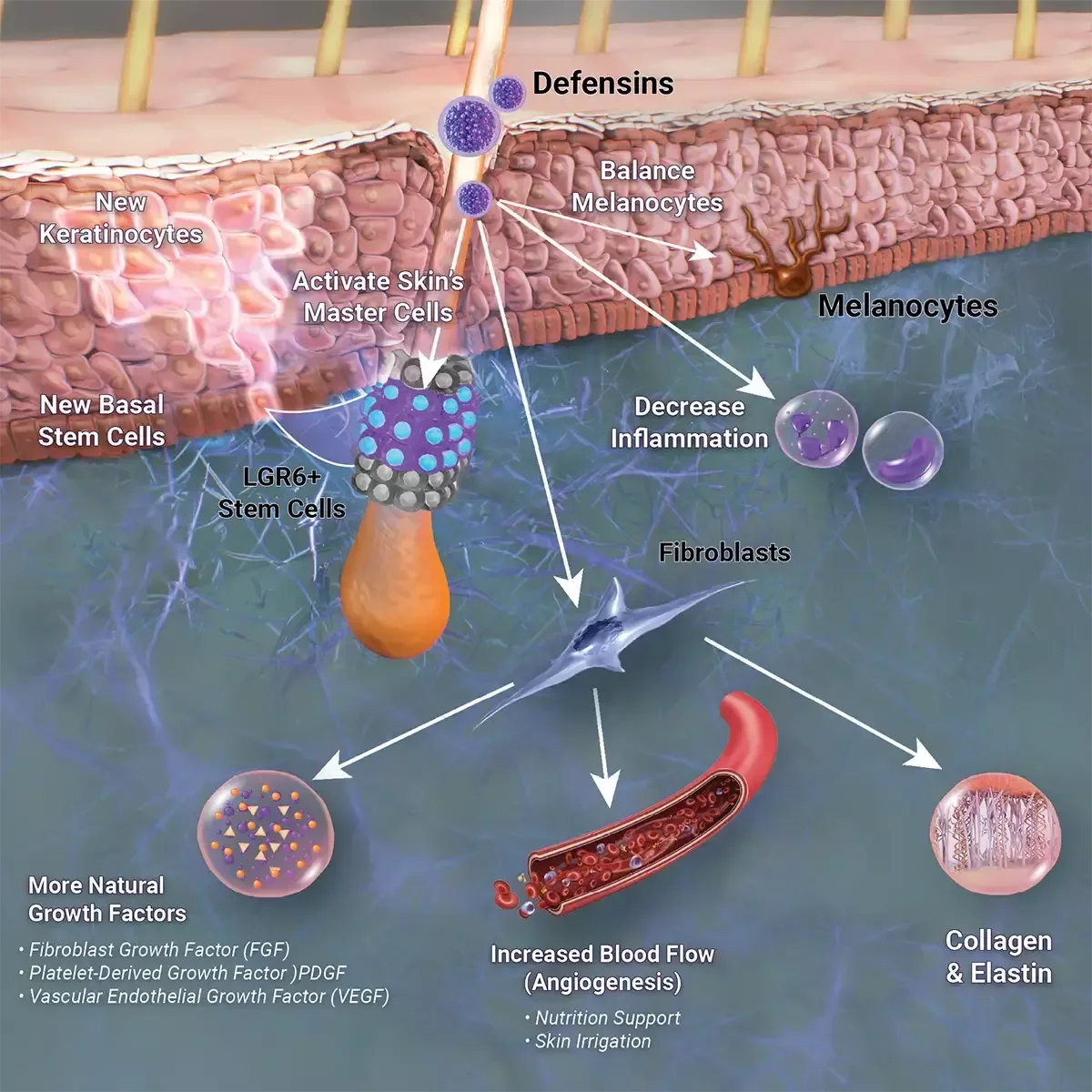
Alpha-Defensin 5 activates LGR6+ stem cells, sometimes called the skin’s “master cells.” These dormant progenitor cells sit at the junction of the epidermis and dermis, waiting for the right signal. When activated, they produce fresh basal stem cells, which generate new, healthy keratinocytes. (Lough et al, 2013)
The result: increased epidermal thickness, improved barrier function, and a visible shift in skin quality that starts at the cellular level.
Beta-Defensin 3
Beta-Defensin 3 signals fibroblasts in the dermis, the cells responsible for producing the structural proteins that give skin its strength, elasticity, and resilience. When activated, fibroblasts initiate: (Takahashi et al, 2021)
- Collagen & elastin production — the structural proteins for firmness and elasticity
- Angiogenesis — new blood vessel formation, improving nutrient delivery
- FGF, PDGF, VEGF release — growth factors that drive continued fibroblast activity, tissue repair, and vascular support
- Inflammation modulation — supports reduction of visible inflammation, creating a favorable environment for renewal
Pigment Regulation via MC1R
Beyond fibroblast activation and inflammation modulation, Beta-Defensin 3 directly regulates melanocyte activity through the MC1R (melanocortin 1 receptor) pathway, the same receptor system that governs how skin produces and distributes pigment. Researchers at Stanford identified that Beta-Defensin 3 functions as a natural endogenous ligand for MC1R. (Candille et al., Science, 2007)
- MC1R is expressed on melanocytes and regulates the type and amount of melanin synthesized, shifting the balance between eumelanin and phaeomelanin
- Beta-Defensin 3 acts as a natural MC1R ligand, meaning the body’s own immune peptide is also a built-in regulator of pigment signaling
- Dual-action on pigmentation: as both an anti-inflammatory and MC1R modulator, it addresses pigment dysregulation from two directions, inflammation triggers and melanocyte signaling
- Patent protected: US Patent 11,020,452 covers defensin compositions and methods for improving skin discoloration, including melasma
Same Molecules. Different Stem Cells.
A Parallel Pathway to Hair Renewal.
The same defensin peptides that drive skin regeneration also activate follicular stem cells through a distinct but equally defined biological pathway.
Alpha-Defensin 5 stimulates the follicular bulge, the region of the hair follicle where LGR5+ stem cells reside, distinct from the LGR6+ population that governs epidermal renewal. These aren’t separate molecules or a different technology. (Lough et al, 2013)

Alpha-Defensin 5
Alpha-Defensin 5 increases LGR stem cell migration into the follicular environment, leading to hair production through the augmentation of key Wnt and wound healing transcripts. The Wnt pathway is the primary signaling cascade responsible for hair follicle development and cycling. When active, follicles enter anagen (growth). When suppressed, follicles enter regression and rest. (Lough et al, 2013)
Beta-Defensin 3
Hair follicles are among the most metabolically active structures in the body. They require a constant, rich blood supply. When that supply diminishes, follicles miniaturize and hair thins. Beta-Defensin 3 enhances angiogenic growth factors (FGF, PDGF, VEGF), increasing fibroblast proliferation and new vessel formation around the follicle. (Takahashi et al, 2021)
Your Hair Has a Signal.
Don’t Let It Fade.
As defensin levels decline with age, so does the biological signaling that keeps follicles active, cycling, and producing. The follicles aren’t gone. They’re waiting for a signal that has grown too quiet to reach them.
84-Day Hair Follicle Pilot Study
An 84-day clinical pilot evaluating topically applied defensin peptides at serum-level concentration on the scalp and follicular environment. The pilot supports the clinical rationale for applying LGR5+ biology and perifollicular angiogenesis science to topical hair formulation.
Scalp & Follicular Environment
Improvements in scalp condition observed across the evaluation period.
Hair Density Appearance
Visible changes in the appearance of hair density from baseline.
Hair Volume & Fullness
Observable shift in the appearance of volume and fullness.
Scalp Skin Quality
Improvements in scalp skin quality parameters noted by evaluators.
The Topical Biostimulator
Injectable biostimulators trigger the body’s own collagen regeneration. Defensin peptides represent the topical expression of that same principle.
PLLA Biostimulator
PLLA microspheres create a controlled inflammatory response that activates fibroblasts. The PLLA degrades over time; the new collagen remains.
Delivery: Administered in-office by injection, typically across multiple sessions.
CaHA Biostimulator
CaHA microspheres provide immediate support and serve as a scaffold for fibroblast migration and collagen deposition.
Delivery: Administered in-office by injection by a trained provider.
Defensin Peptides
Patented Age-Repair Defensins® peptides activate the same downstream biology through defined receptor-mediated pathways (FGFR1/JAK2/STAT3) rather than controlled injury. (Takahashi et al., 2021)
Advantage: Non-invasive, daily application, no procedural risk. Works continuously.
Defined Regeneration vs. Undefined Biologics
Defensins- The “Key”
One key, one lock, one predictable outcome
Biologics- The “Key Ring”
A ring full of keys hoping one fits
The Research Behind Defensin Peptide Science
Peer-reviewed, published, and growing.
Stimulation of LGR5+ and LGR6+ Stem Cells with Alpha-Defensin 5
The landmark study establishing that Alpha-Defensin 5 increases LGR stem cell migration into wound beds. Demonstrated defensin activity across both skin regeneration (LGR6+) and hair follicle activation (LGR5+) through Wnt pathway augmentation.
Beta-Defensin 3 & MC1R Pigment Regulation
Established Beta-Defensin 3 as a natural ligand for the MC1R melanocortin receptor, linking defensin biology to pigment regulation.
Beta-Defensin 3, Cytokine Production & Angiogenesis
Beta-Defensin 3 induces FGF, PDGF, and VEGF secretion in a dose-dependent manner. Demonstrated fibroblast proliferation and new blood vessel formation.
Age-Related Decline of Alpha-Defensin 5
Individuals over 70 demonstrate a 30%+ decrease in Alpha-Defensin 5 levels compared to middle age.
84-Day Hair Follicle Pilot Study
84-day clinical pilot evaluating topically applied defensin peptides at serum-level concentration on scalp and follicular environment.
Skin Cell Turnover and Aging
Foundational research establishing the progressive slowdown of epidermal cell turnover from ~28 days in young adults to 75-90 days in older adults.